


Two-Leaf Example
A 20′ opening with approximately 10′–12′ of available run-back can typically be planned as two overlapping gate leaves using one synchronization mechanism.
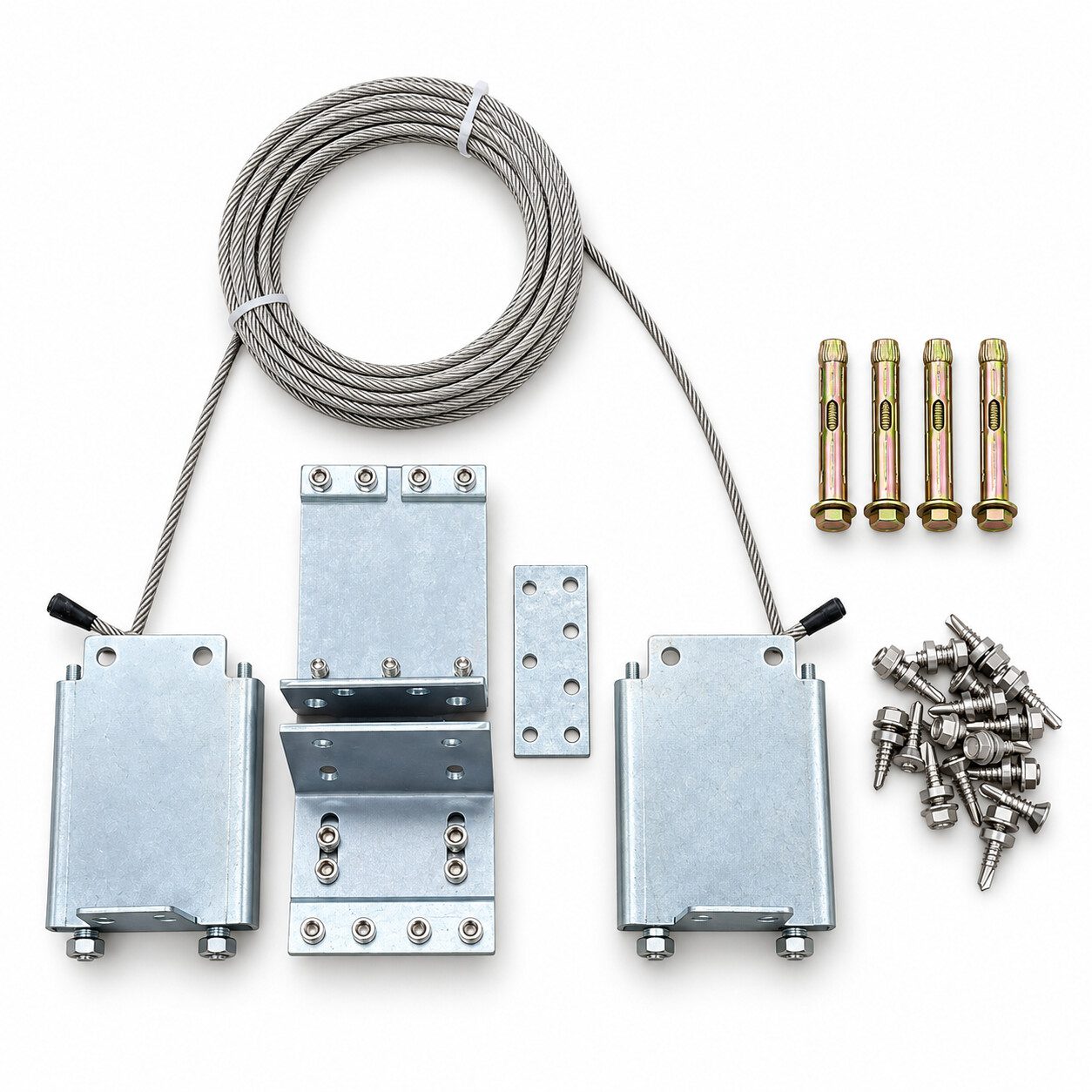


The Heavy-Duty Telescopic Sliding Gate Hardware Kit converts compatible sliding gate leaves into a synchronized telescoping system for wide openings with limited side run-back. Instead of one full-width gate sliding completely beside the opening, multiple gate leaves travel on parallel tracks and overlap as they open.
A stainless steel cable routed through sealed-bearing pulleys transfers movement from the driven gate leaf to the next leaf. The leaves move together at coordinated travel rates, allowing the full opening to clear while the stacked gate occupies substantially less space than a conventional single-panel sliding gate.
Each kit provides the mechanism required to synchronize one additional gate leaf. Use one mechanism for a two-leaf telescopic gate, two mechanisms for a three-leaf gate, or three mechanisms for a four-leaf gate. Alumission recommends up to four individual gate leaves. Gate leaves, tracks, wheels, guides, operator, rack, and safety equipment are not included.
A telescopic sliding gate divides the total opening into shorter leaves that overlap when open.
A 20′ opening with approximately 10′–12′ of available run-back can typically be planned as two overlapping gate leaves using one synchronization mechanism.
When a 20′ opening has only about 7′ of run-back, three shorter gate leaves can be planned with two mechanisms, subject to required overlap and installation clearances.
Each leaf travels on its own properly aligned track and stacks beside the opening.
Final leaf widths must include overlap, hardware positions, stops, and required clearances—not only the clear opening divided by the number of leaves.
The mechanism transfers motion between adjacent sliding gate leaves.
On a motorized system, the gate operator drives the lead leaf; the cable-and-pulley mechanism transfers motion to the connected leaf.
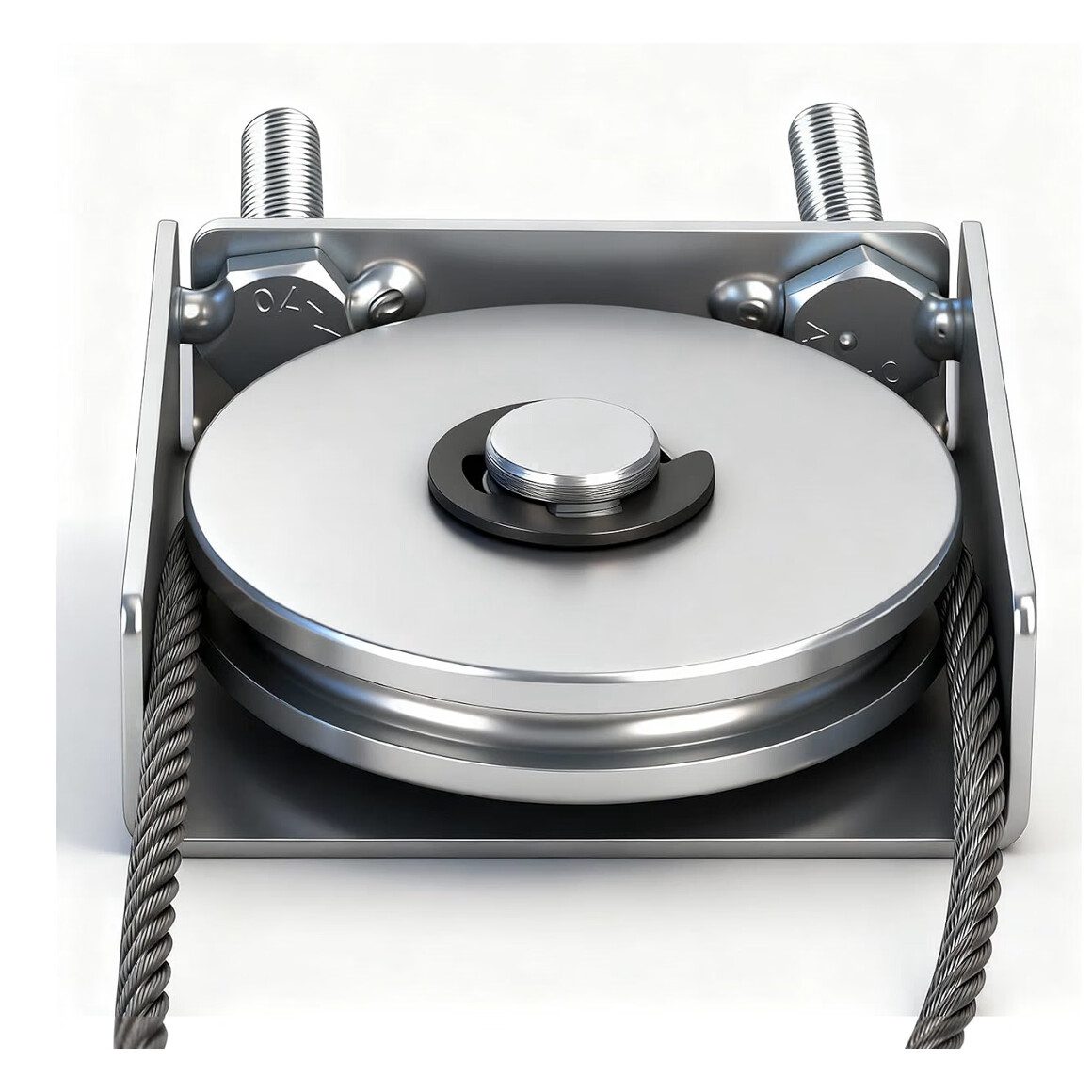
The pulleys use sealed bearings to reduce friction and support smooth repeated movement.
The included 33 ft stainless steel cable routes through the pulley assemblies to synchronize adjacent leaves.
Bracket positions and cable tension must be set during installation for smooth coordinated travel.
Choose the mechanism quantity from the number of individual gate leaves in the design.
Use 1 telescopic mechanism.
Use 2 telescopic mechanisms.
Use 3 telescopic mechanisms. Four leaves is Alumission’s recommended maximum.
Consult Alumission before designing a system with more than four leaves.
Correct track layout, gate construction, guidance, stops, and cable setup are essential.
Gate leaves, ground tracks, wheels, upper guides, catcher, motor, rack, controls, and safety devices are sold separately.
Parallel tracks and guide components must be level, straight, and correctly spaced to prevent binding.
Route and tension the cable according to the completed gate layout, then test the full travel manually before automation.
Telescopic and motorized gates should be planned and installed by qualified gate professionals familiar with synchronized multi-leaf systems.
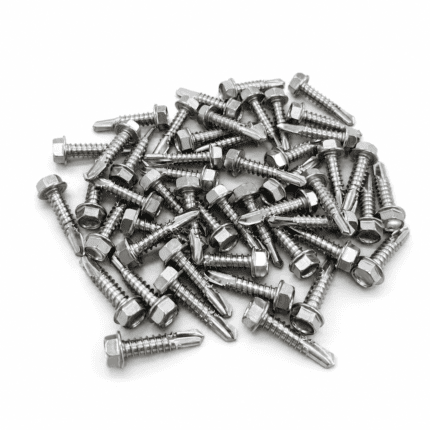
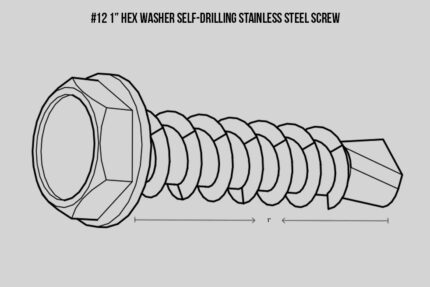
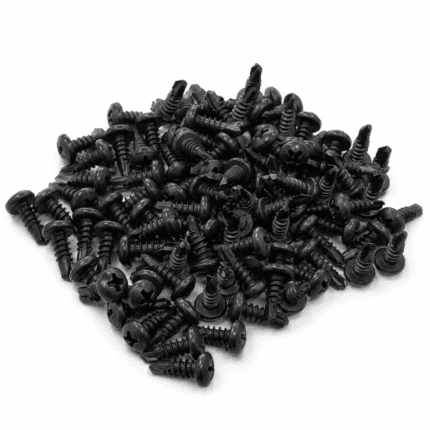
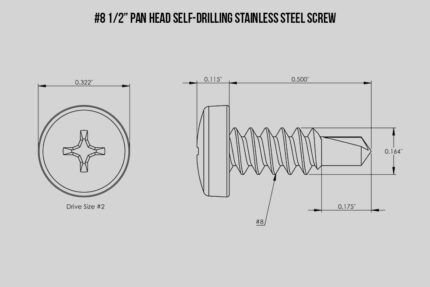
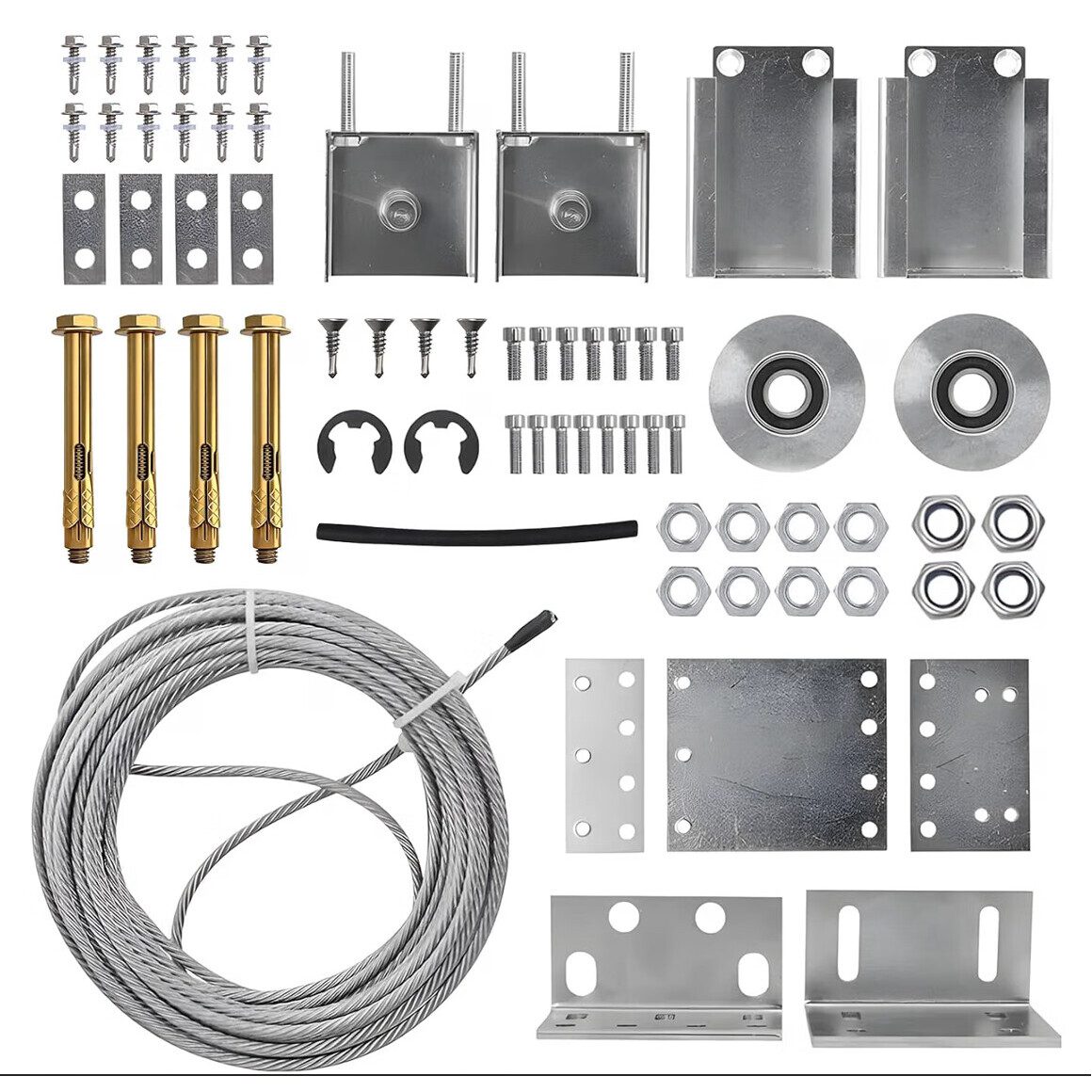
Included: One telescopic sliding gate synchronization mechanism with 33 ft stainless steel cable, sealed-bearing pulley assemblies, galvanized brackets, connector plates, expansion anchors, mounting bolts, and the supplied fasteners shown.
Sold separately: Gate leaves and frames, ground tracks, V-groove wheels, upper guides, posts, gate catcher and stops, gate operator or motor, rack or drive hardware, electrical controls, access-control equipment, safety devices, concrete, and installation tools.
Review the included components and configuration requirements before designing the gate leaves, parallel tracks, guidance system, stops, and operator.
The installer is responsible for final gate-leaf sizing, overlap, track spacing, structural design, cable routing, cable tension, stops, operator sizing, and safety devices for the actual opening, gate weight, wind exposure, cycle rate, and site conditions.
Answers about space savings, number of mechanisms, included components, gate sizing, and motorized operation.
It synchronizes adjacent sliding gate leaves so they travel together and overlap beside the opening, reducing the side run-back space required.
No. This product is the cable-and-pulley synchronization mechanism only. Gate leaves, tracks, wheels, guides, motor, rack, stops, and safety equipment are sold separately.
Multiple gate leaves travel on parallel tracks. As the lead leaf moves, the cable-and-pulley mechanism transfers movement to the connected leaf so the panels open together and stack in a shorter side area.
Yes, when the complete manual gate system is properly designed, aligned, and balanced.
Yes. In a properly designed automatic system, the operator drives the lead leaf and the telescopic mechanism transfers movement to the following leaf or leaves.
Use one mechanism for a two-leaf telescopic sliding gate.
Use two mechanisms so each additional leaf is synchronized.
Use three mechanisms. Alumission recommends a maximum of four individual gate leaves.
A two-leaf telescopic layout can often make this possible using one mechanism, subject to the required leaf overlap, track layout, stops, and installation clearances.
A three-leaf layout using two mechanisms may be appropriate. Final leaf dimensions must be calculated for overlap and hardware clearances, so divide-by-three dimensions alone are not the finished fabrication sizes.
The kit includes 33 ft of stainless steel cable, sealed-bearing pulley assemblies, galvanized brackets and connector plates, expansion anchors, mounting bolts, and the supplied fasteners shown.
No. Select compatible tracks, wheels, and upper guides for each gate leaf separately.
No. The gate operator, rack or drive hardware, controls, electrical components, and safety devices are sold separately.
Each gate leaf needs its own aligned travel path so the leaves can move beside and overlap one another without binding.
Installation is recommended for qualified gate professionals experienced with sliding gate alignment, cable tensioning, multi-leaf synchronization, and automated gate safety.
Discussions
There are no questions yet.