

Zone 0 Fencing in California: Aluminum Fence & Gate Guide
Understand California Zone 0 fencing guidance, evaluate aluminum fences and gates, and use a practical checklist before replacing a fence near your home.
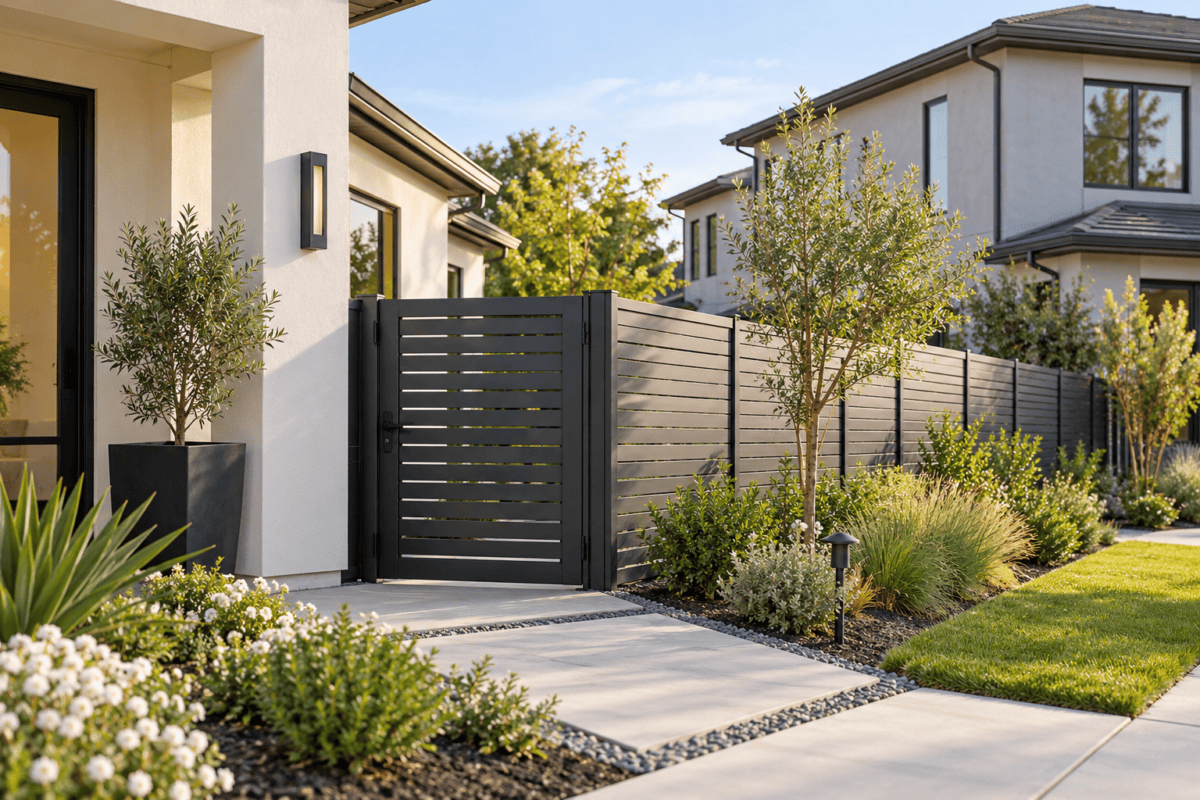
The best fence for an HOA community is one that fits the approved design, the property, and the way the homeowner wants to use the yard. A beautiful product is only part of that decision. Your application should make the proposed height, location, finish, gate layout, and installation details easy for the architectural committee to understand.
This guide explains how to prepare for HOA fence approval, why aluminum is worth considering, and what to include before you order. It is useful for homeowners proposing a single side gate and for boards considering a consistent fence design across a community.
Prepared October 16, 2026. The featured image is an AI-generated design concept, not a photograph of an HOA-approved project. Approval requirements depend on your community and location.
HOA approval normally relates to a particular proposal under a particular community’s governing documents. It is not a universal certification attached to a brand. A fence approved for one home may have a different allowed height, location, or appearance at another property.
Alumission fences have been approved and recommended in HOA communities, according to Alumission’s experience shared for this guide. That history can help start a discussion, but it does not replace written approval from your own association. Ask the team whether it can provide a relevant project example or product information for your application.
Keep three decisions separate: what your HOA accepts, what your local authority permits, and what the installation design requires. For example, the City of Orlando’s official Fence Guide says fences must comply with city code even where a permit is not required, and notes the separate need for HOA approval. That is a useful illustration of the distinction, not a nationwide set of fence dimensions.
A defined fence specification can help neighboring homes look consistent without leaving each owner to interpret a vague request for “modern fencing.” Agree on a named style, finish, height, slat arrangement, and gate treatment. Review actual samples where possible; a screen image can make two different finishes look deceptively similar.
A homeowner seeking privacy and a committee protecting open views may have different priorities. Compare the amount of visual screening in the exact design instead of assuming all aluminum fencing is open picket fencing or that every horizontal design provides full privacy. Show the proposal from both the street and neighboring-property perspectives.
Aluminum avoids wood-specific issues such as rot and termite damage. It still needs routine cleaning and checks of the finish, fasteners, hinges, and latches. Ask for the care instructions for the selected product and environment, especially where salt, irrigation spray, or landscaping chemicals may contact the fence.
For a board, a maintenance plan should also identify who handles accidental damage and how replacement components will be selected. Do not assume every style or finish will remain available indefinitely; ask about current replacement options and record the specification.
In wildfire-prone communities, noncombustible aluminum components can be part of a discussion about replacing combustible fence-to-house connections. The complete assembly and local requirements still matter. Read our California Zone 0 fencing guide before combining a design application with a fire-mitigation project.
Ask the manager or architectural committee for the current application form, design guidelines, relevant CC&Rs, submission method, review schedule, fees, and any required neighbor acknowledgments. Confirm whether replacement fencing requires a new application even when the proposed appearance seems similar.
Read the wording carefully. A guideline that allows a material may still restrict its style, location, or color. If a rule is unclear, ask a specific question with an image or drawing attached rather than relying on a verbal interpretation.
Use the property information required by your association and local authority. Identify shared fences, common areas, easements, utility access, and any slope changes. A contractor’s estimate is not proof of a legal boundary. Resolve uncertain ownership or access before committing to installation.
Select a primary design with its height, finish, panel layout, gate location, and mounting approach. If you want an alternative, label it separately. Multiple unlabeled inspiration photos can leave the reviewer unsure which details you intend to build.
Include the checklist below and retain a copy of everything submitted. Ask for acknowledgment of receipt and confirm whether the application is complete enough to enter review. If the committee requests changes, submit a dated revision so everyone is reviewing the same plan.
Read every condition attached to the approval. Confirm that the approved finish, dimensions, and location match your order. Do not assume silence or a neighbor’s verbal approval is permission to start; use the process in your governing documents and applicable law.
Give the installer the approved version. Document changes before construction, retain any required permits, and arrange final review if your association requires it. Keep the approval, invoice, product details, and care information together for future repairs or a property sale.
A useful drawing does not need decorative detail. It needs to answer: where will the fence go, how high will it be, what will it look like, and how will the gate operate? If the review requires a survey or professional plan, a homeowner sketch is not a substitute.
Begin with the community’s requirements and compare them with the exact product you want. Explore Alumission aluminum fence kits for fence runs, or side-yard gate options when access is the main need. Use the project gallery for appearance ideas, then confirm the actual configuration in your quote.
Send Alumission the design guidelines, your proposed dimensions, site photos, and finish preference. Ask which product documents are available for the committee. Keep requests precise: “We need the material, finish, overall height, and slat-spacing details for this configuration” is easier to answer than “Is this HOA approved?”
For a coordinated community project, a board can prepare a standard specification and a list of acceptable variations. Consider corner lots, slopes, gates, shared boundaries, and visibility before making one photograph the standard for every home.
I am requesting architectural approval to install the aluminum fence and gate shown in the attached plan at my property. The submission identifies the proposed location, height, finish, panel design, and gate swing, along with current site photos and product information.
Please let me know whether any additional documents or revisions are required. I will confirm the applicable permit and installation requirements and will not begin work until the required approvals are complete. Please provide the decision and any conditions in writing.
Add your address, exact product specification, and the details required by your association. This is a starting point for a submission, not a guarantee of approval.
Ask which written guideline the proposal does not satisfy and whether a specific revision would resolve the concern. It may be the height, location, finish, or panel arrangement rather than the material itself. Submit a focused revision instead of changing several details without explanation.
For California communities, California Civil Code Section 4765 addresses architectural review where association approval is required. Its provisions include a fair, reasonable, and expeditious procedure, written decisions, and specified reconsideration rights. Review the current text and your governing documents; other states have different rules. A disputed decision may warrant advice from a qualified local professional.
Material and design are separate questions. Review the community’s rules for the proposed height, color, slat arrangement, location, and gate appearance. Get a decision on the complete proposal.
No. The neighboring installation may have been approved under different rules, may occupy a different type of lot, or may not be an approved example at all. Reference it as inspiration and request your own written decision.
Finalize the approved specification first. Ordering too early can leave you with the wrong finish, height, or configuration. Ask about lead times and quote validity while the application is under review.
No. Confirm permitting separately with the local authority. An association’s design decision does not establish compliance with building, access, pool, or fire requirements.
A board can evaluate Alumission’s available products against its community standards and applicable requirements. Record the exact accepted configurations and approval process rather than relying on a brand name alone.
A strong application connects an attractive design with precise product and site information. Request an Alumission fence or gate quote and share your HOA requirements so you can compare suitable options before submitting the final plan.
External links are provided for reference. Agency guidance and legal examples do not constitute an endorsement of Alumission or approval of a specific installation.
Explore products, installation resources, and advice from our team.
More ideas and practical guidance for your outdoor project.
Understand California Zone 0 fencing guidance, evaluate aluminum fences and gates, and use a practical checklist before replacing a fence near your home.
The Rise of Non-Combustible Aluminum Fences: Addressing California’s New Fire Safety Law For Fireproof Fencing In response to the escalating
The Role and Importance of Housing Fence : Enhancing Security, Privacy, and Aesthetic Appeal In the realm of residential architecture,
Fill out the details below and we’ll get back to you shortly!
